Tổng quan bài viết
Đăng bởi: Khang Dương 9/6/2026
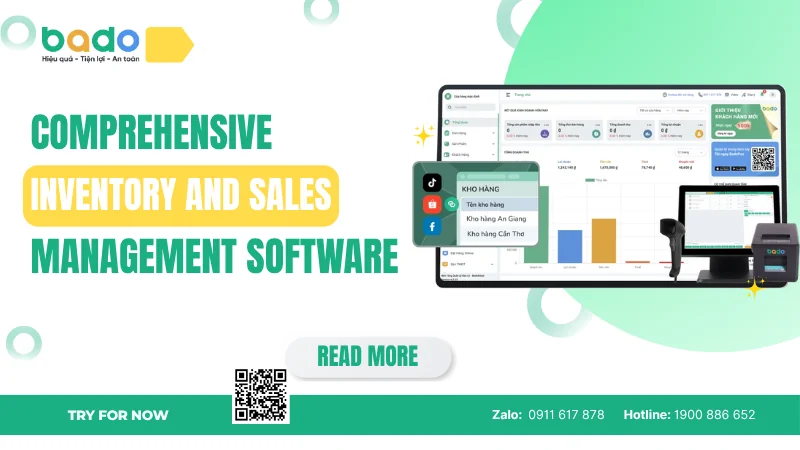
Comprehensive inventory and sales management software is a system that helps business owners manage two of the most important operations in commerce at the same time: sales and inventory. Instead of selling in one place, recording stock in another place, managing purchasing through a separate Excel file, and manually calculating revenue at the end of the day, the software connects data from product creation, purchasing, sales, stock deduction, inventory checks, customers, receivables, and business reports.
The core value of this type of software is not only knowing “how much was sold,” but also knowing “how inventory changes after each sale.”
In reality, many stores, household businesses, and SMEs do not struggle because they cannot sell. They struggle because they cannot control inventory after selling:
A business may generate revenue but not know which products are running out.
It may purchase goods but not know which items have been sitting too long.
It may have many orders, but stock records do not match reality.
It may have fast-selling products but fail to restock in time.
It may have slow-moving stock but continue purchasing based on habit.
This is why inventory and sales management software should be considered one of the most important foundations of business operations for a modern small and large business solution.
Criteria
Separate Sales Management
Comprehensive Inventory and Sales Management
Order creation
Records revenue and transactions
Records transactions and updates inventory
Inventory
Updated manually or in a separate file
Changes automatically through stock in, stock out, and sales
Purchasing
Tracked separately
Connected with products and stock levels
Stock checks
Time-consuming and prone to mismatch
Has system data for faster reconciliation
Reports
Mainly revenue reports
Revenue, best-selling products, inventory, slow-moving stock
Decision-making
Based heavily on intuition
Based on sales and inventory data
For Bado, comprehensive inventory and sales management software should not be understood simply as a stock in/out tool. The right positioning is that Bado helps business owners see the flow of goods from purchasing to selling, while turning sales data into a foundation for inventory control, purchasing decisions, customer management, receivables tracking, and business reporting. This is how Bado helps stores, household businesses, and SMEs move from fragmented management to data-based management. If you want to eliminate upfront costs while organizing your business, you can get started with Bado free sales management software.
Sales and inventory management cannot be separated in a business that sells physical goods. A sale does not only create revenue; it also changes stock quantity. A purchase does not only increase inventory; it also affects capital, selling capacity, pricing strategy, and business planning.
If these two data sets are disconnected, business owners will struggle to understand the true condition of their store or company. According to commercial data compiled by the General Statistics Office of Vietnam, poor alignment between stock control and sales metrics is a leading driver of operational confusion, product loss, and wrong purchasing decisions in commercial enterprises.
Inventory Mismatch and Virtual Stock: Staff may sell at the counter, shop owners may close orders online, another person may deliver or dispatch goods from the warehouse, but if data is not updated in the same flow, stock records will not reflect reality. Business owners may see that the system still has stock while shelves are already empty, or they may think a product is out of stock while it is still available in the warehouse. Both situations cause damage: stockouts lead to missed revenue, while inaccurate stock records tie up capital and make stock checks time-consuming.
Poor Purchasing Control: Without sales data connected to inventory, purchasing decisions often rely on intuition. A store owner may feel that a product “seems to sell well” and buy more, assume there is still enough stock and delay purchasing, or continue buying based on old habits without looking at actual sell-through speed. This creates two major risks: lacking fast-moving products and overstocking slow-moving products. For industries with short product life cycles such as the fashion and service business solution sector, cosmetics, accessories, food, consumer goods, or seasonal agricultural supplies, wrong purchasing decisions can directly affect cash flow.
Inadequate Revenue Reporting: Revenue reports alone are not enough for decision-making. A store may have good daily revenue, but if that revenue comes from clearing old stock with low margins, it may not be a truly positive sign. A product may sell very well, but if inventory is low, it must be restocked immediately. A product group may take up a large amount of warehouse space but sell slowly, requiring a clearance or promotion plan. Therefore, sales reports must go together with inventory reports so business owners can see the complete operating picture.
Disconnected Data
Problem Created
Business Impact
Orders do not deduct stock
Virtual inventory and overselling
Poor customer experience and delivery issues
Purchasing is not based on sales speed
Overstock or stockouts
Capital tied up or lost revenue
Stock checks lack system data
Slow reconciliation
Hard to detect product loss
Reports show only revenue
Product performance is unclear
Decisions lack reliable context
Online and offline sales are not synchronized
Stock mismatch across channels
Missed or duplicated orders
Multiple staff sell at the same time
Transactions are hard to trace
Accountability becomes unclear
Comprehensive inventory and sales management software should cover key operations from sales, products, purchasing, stock-out, stock checks, inventory, customers, receivables, to reports. However, the important point is not having many isolated features. The features must connect according to the real operating flow. When goods are purchased, the system records quantity. When goods are sold, inventory changes. When stock is checked, the system helps compare data. When reports are reviewed, business owners need to see both revenue and inventory status.
This is the first foundation of inventory and sales management. The software should allow users to create product catalogs, product codes, barcodes, units of measurement, product groups, selling prices, cost prices, suppliers, and product status. For stores with many product models, products must be organized clearly so staff can find them quickly when selling, warehouse staff can control them when receiving stock, and business owners can view reports accurately. If product catalogs are messy from the beginning, all sales and inventory data behind them will become unreliable.
Each sale should clearly record the product, quantity, selling price, customer, payment method, and staff member handling the transaction. After the order is completed, the software should automatically update inventory based on the quantity sold. This is the most important connection between sales and inventory. If sales are completed but stock does not change, business owners still have to deduct stock manually, which easily leads to errors.
In addition to sales, the software should support purchasing from suppliers, internal stock-out, stock adjustments, physical stock checks, and variance recording. For businesses with multiple warehouses or stores, stock transfers between locations are also important. Inventory checking should not only be a monthly counting activity. It should rely on system data so discrepancies can be identified faster and unusual movements can be detected.
Reports should combine revenue and product data. Business owners need to know which products sell best, which items sit in stock too long, which product groups generate strong revenue, which items are nearly out of stock, which products need restocking, which products need promotion, and whether current inventory matches sales speed. This is the layer that helps business owners make decisions rather than simply view numbers.
Feature Group
Role
Practical Value
Product management
Product codes, prices, categories
Clear product data
POS/Sales
Create orders, process payments, record transactions
Faster selling and fewer mistakes
Automatic stock deduction
Updates stock when sales occur
Reduces inventory mismatch
Records goods entering the warehouse
Controls incoming stock
Stock-out/Adjustment
Records internal stock-out, loss, adjustment
Easier stock reconciliation
Inventory checks
Compares system stock with physical stock
Detects discrepancies
Customers/Receivables
Stores buyers and amounts due
Suitable for retail, wholesale, regular customers
Revenue, best-selling products, inventory
Supports purchasing and decision-making
Inventory and sales management software sits between two common types of tools: sales software and standalone inventory software. If this distinction is not clear, SEO content can easily overlap:
Basic Sales Software: Can help a store create orders faster, calculate payments more accurately, and view daily revenue. However, if the software does not update inventory or only updates it in a very basic way, business owners still do not know exactly how much stock remains. This is especially risky for stores with many SKUs, multiple sales channels, or several staff members selling at the same time. The more transactions the business has, the higher the risk of inventory mismatch if there is no connected system.
Standalone Inventory Software: May record stock in/out well, but if it does not connect with sales, stock data is still updated slowly. Sales staff create orders in one tool, warehouse staff update stock in another, and accounting or the owner summarizes data in a different file. Every time data passes through many people and many tools, the risk of error increases. When inventory mismatch is discovered, it becomes difficult to know whether the problem came from a sale, purchasing, internal stock-out, product return, or stock check.
Comprehensive Inventory and Sales Management Software: Solves this by placing sales transactions and inventory movements in the same data flow. A sale does not only record revenue; it also deducts stock. A purchase does not only increase inventory; it also helps the owner understand future selling capacity. A report does not only show how much money came in; it shows how products are moving.
Sales Software
Standalone Inventory Software
Comprehensive Inventory and Sales Management Software
Main focus
Orders, payments, revenue
Stock in/out, stock checks
Connects sales and inventory
Sales data
Clear
Not the main focus
Clear and linked with stock
Inventory data
May be basic
Very clear
Clear and updated by transaction
Mainly revenue
Mainly inventory
Revenue + inventory + product movement
Best suited for
Stores with few SKUs
Separate warehouse operations
Stores, household businesses, and SMEs needing sales and inventory control
Risk if used separately
Inventory mismatch
Slow updates from sales
Lower risk due to connected data
Bado defines comprehensive inventory and sales management software as a platform that helps business owners control the flow of goods and sales transactions in one system. In this definition, sales and inventory are not separate parts. Sales are the point where goods decrease. Purchasing is the point where goods increase. Inventory checks are the point where system data is compared with physical reality. Reports are where this data becomes business decisions. This is how Bado focuses on data connectivity.
For retail stores, Bado helps owners create products, sell, deduct stock, receive goods, check inventory, and view reports in an easy-to-understand way. For household businesses, Bado helps reduce dependence on notebooks, memory, and Excel. For SMEs, Bado helps standardize product, transaction, and inventory data so the business can expand with more staff, more selling points, or more warehouses. The common need across all models is knowing where goods are, how they are sold, and what that data says about business performance.
Bado helps business owners manage goods from the moment they enter the system. Products should have codes, prices, categories, units of measurement, and stock quantities. When goods are purchased, inventory increases. When goods are sold, inventory decreases. When returns, adjustments, or stock checks occur, data should be updated clearly. This data chain helps business owners understand the product life cycle inside a store or company.
An order is not only revenue. An order also shows which products the market is buying, which product groups have strong demand, which items need to be restocked, and which items may run out soon. When sales data is connected with inventory, reports become more meaningful. Business owners do not only view “how much was sold today.” They also see “what was sold today, what remains in stock, and what should be done next.”
Inventory management is often seen as complicated, especially for household businesses and small stores. Therefore, Bado should define comprehensiveness through ease of deployment. Business owners can begin with basic operations such as creating products, receiving stock, selling, and viewing inventory. Later, as needs grow, they can expand into stock checks, receivables, multiple warehouses, multiple stores, advanced reports, or e-invoices.
How Bado Understands “Comprehensive”
Practical Meaning
Comprehensive in products
Product codes, categories, selling prices, units
Comprehensive in purchasing
Records incoming goods and quantity increases
Comprehensive in sales
Creates orders and updates quantity decreases
Comprehensive in inventory checks
Comprehensive in reports
Revenue, best-selling items, slow-moving stock, low-stock items
Comprehensive in scalability
Suitable for small stores to multi-location SMEs
With this definition, Bado can hold the position of a comprehensive inventory and sales management platform without falling into two extremes: too simple like a checkout tool, or too heavy like a complex warehouse management system. Bado should be understood as a practical solution that helps business owners control products and transactions more clearly, allowing operations to become more sustainable.
Reducing Inventory Mismatch: This is a common problem for stores, household businesses, and SMEs that manage physical goods. When sales are connected with inventory, each order can update stock quantity. Business owners no longer need to wait until the end of the day or week to deduct stock manually. Inventory data therefore has a stronger basis for accuracy, helping reduce situations where stock records show available products but shelves are empty, or physical stock exists but system data does not reflect it.
Smarter Purchasing and Optimized Cash Flow: When business owners can see which products sell quickly, which products move slowly, which items are nearly out of stock, and which items sit too long, purchasing decisions become less dependent on intuition. This directly affects cash flow. Buying too much slow-moving stock ties up capital. Buying too little fast-moving stock leads to missed revenue. A strong inventory and sales management system helps business owners balance sales demand with available stock.
Minimizing Product Loss: Product loss can come from many causes: selling without deducting stock, receiving the wrong quantity, staff mistakes, damage, missing items, unrecorded returns, or irregular stock checks. When purchasing, stock-out, sales, and inventory checks are recorded in the system, business owners have a stronger basis for tracing issues and detecting unusual changes.
High-Value Management Reports: Revenue reports alone only show how much was sold. When combined with inventory data, reports can show which products contribute revenue, which items tie up capital, which product groups need promotion, which items should be restocked, and whether current inventory matches sales speed. This data layer is essential for managing stores and SMEs.
Benefit
Less inventory mismatch
Stock updates more clearly after sales
More accurate purchasing
Based on sales speed and actual inventory
Less product loss
Data helps trace purchasing, stock-out, sales, and checks
Time saving
Reduces manual calculation and reconciliation
Better control of best-sellers
Identifies products that need restocking
Better handling of slow-moving stock
Identifies items with low turnover
Better reports
Combines revenue and product data for decisions
Easier expansion
Builds a data foundation for more staff, warehouses, or stores
Bado’s comprehensive inventory and sales management software is suitable for business models that manage physical goods, have frequent transactions, and need clear inventory control:
Retail Stores with High SKU Volume: Such as grocery stores, mini supermarkets, fashion shops, cosmetics shops, mother-and-baby stores, phone shops, accessories shops, pharmacies, construction material stores, paint stores, and agricultural supply stores. These models usually have many SKUs, different selling prices, recurring purchases, and a high risk of inventory mismatch if they manage manually.
Household Businesses and Personal Shops: Moving from manual recording to software-based management. For this group, Bado makes starting easy: create products, receive stock, sell, view inventory, and view reports. Household businesses do not need a complicated system from day one, but they need reliable data to avoid confusion when order volume increases or staff are added.
Growing Small and Medium Enterprises (SMEs): With multiple employees, selling points, or warehouses. For this group, the need is not only faster selling, but also controlling product data across locations. Businesses need to know stock by branch, which items should be transferred, which selling point performs well, which warehouse has excess stock, and which products need restocking. If data is not synchronized, businesses face inventory mismatch, inaccurate reports, and slow decisions. Implementing an e-commerce website design can also help these SMEs perfectly synchronize physical stock with digital sales channels.
Business Model
Main Need
Value Bado Provides
Grocery stores/mini supermarkets
Many SKUs, fast selling, inventory
Product management and stock deduction by order
Fashion stores
Sizes, colors, models, seasonal stock
Tracks best-sellers and slow-moving stock
Cosmetics/mother-and-baby stores
Many products, regular customers, frequent purchasing
Controls catalogs, inventory, and customers
Agricultural supply stores
Products, regular customers, receivables
Tracks sales, stock, and amounts due
Pharmacies
Products, inventory, transaction data
Clearer product management
Phone/accessories stores
Product codes, models, inventory
Product and sales report management
Small household businesses
Start managing systematically
Easy to use and reduces reliance on notebooks
Multi-warehouse/multi-location SMEs
Inventory and report synchronization
More centralized data control
This pillar article should not go too deeply into each industry. Its role is to define the broad cluster of “inventory and sales management.” From this article, Bado can lead readers to cluster articles such as inventory management software for grocery stores, inventory management for fashion shops, agricultural supply inventory management software, pharmacy inventory management software, stock in/out management software, mobile sales and inventory software, multi-branch inventory management software, and inventory management solutions for SMEs.
In alignment with framework criteria from the official Digital Transformation Support Portal for Businesses, selecting a tool involves analyzing the deep connection between core data sets rather than just relying on superficial aesthetics. Business owners should not only look at low price or a beautiful interface. Inventory-related software must be accurate, easy to use, and suitable for the real sales workflow:
If the software is too complicated, staff may avoid entering data.
If the software is too simple, inventory data may not be enough for control.
If sales and inventory do not connect properly, business owners still have to reconcile data manually.
Therefore, the most important criterion is data connectivity between sales, purchasing, inventory, and reports.
Ease of Sales Operation: Staff need to create orders quickly, select products easily, record payments clearly, and avoid too many steps. If sales operations are difficult, input data will be incomplete, causing inventory and reports to become inaccurate.
Strong Product Management: The software should support product codes, categories, units of measurement, selling prices, cost prices, and stock quantities. For businesses with many SKUs, clear product catalogs are essential.
Comprehensive Stock Checking and Adjustments: Business owners need to know when products came in, when they were sold, how much remains, how much discrepancy appears after stock checks, and why adjustments were made.
Easy-to-Understand Reporting Workflows: Reports should not only show stock quantity. They should help owners identify best-selling products, slow-moving items, low-stock products, and inventory value.
Scalability and Expansion Support: As the business grows, the software should support more staff, warehouses, stores, or advanced reports.
Question to Ask
Why It Matters
Easy selling
Can staff create orders quickly?
Sales data is the input for inventory
Does it support product codes, categories, prices, and units?
Prevents catalog confusion and data errors
Stock deduction by order
Does inventory update after sales?
Can it record incoming stock and quantity?
Controls incoming goods
Can it compare system stock with physical stock?
Inventory reports
Does it show best-sellers, slow-moving stock, and low-stock items?
Supports purchasing decisions
Scalability
Can it add warehouses, stores, and staff?
Supports business growth
Implementation support
Are there clear usage guides?
Helps users adopt the system correctly
Comprehensive inventory and sales management software is a platform that helps business owners connect two of the most important data sets in goods-based operations: sales transactions and inventory. As stores, household businesses, and SMEs increasingly manage more SKUs, sales channels, staff members, and reporting needs, managing sales in one place, inventory in another, and reports somewhere else is no longer sustainable.
Bado believes that inventory and sales management should not be treated as two separate jobs. Every order should change stock. Every purchase should support sales planning. Every stock check should help reconcile data. Every report should show not only revenue, but also product status. In Bado’s view, “comprehensive” means connecting sales, products, stock in/out, customers, receivables, and reports in a way that is easy to use, easy to deploy, and suitable for real business conditions in Vietnam.
For small stores, Bado helps reduce inventory mismatch and make sales data clearer. For household businesses, Bado helps gradually replace notebooks and Excel with a more systematic data foundation. For SMEs, Bado helps standardize product, inventory, and transaction data so they can expand with more staff, warehouses, or selling points. This is why Bado positions itself not only as sales software and not only as inventory software, but as comprehensive inventory and sales management software.
Comprehensive inventory and sales management software is a system that helps business owners manage sales, products, purchasing, stock-out, inventory, customers, receivables, and reports at the same time. The key point is that sales data and inventory data are connected. When sales happen, inventory updates; when goods are received, stock quantity changes; when reports are viewed, business owners can see both revenue and product status.
Sales software usually focuses on order creation, payments, and revenue. Inventory and sales management software goes deeper into product control, including stock in/out, stock checks, best-selling items, slow-moving stock, and low-stock items. Sales is the point where transactions happen, while inventory management helps control goods after each transaction.
Yes. Small stores still need to know what is in stock, what is out of stock, which products sell best, and which product groups generate revenue. If they only use notebooks or Excel, inventory mismatch can happen easily and purchasing decisions become unclear. Software helps small stores manage more systematically without needing an overly complicated system.
Bado is positioned to support stores, household businesses, and SMEs in managing products, purchasing, sales, inventory, and reports. When transactions are recorded in the system, business owners have a clearer basis for tracking product movements. Depending on real needs, users can be advised on the right configuration for their industry and scale.
Yes. When sales and inventory are managed in one system, each order can become data that changes stock quantity. This helps reduce forgotten stock deductions, overselling, or not knowing which items are out of stock. However, accurate data also depends on consistent software usage and regular inventory checks.
A business should move when Excel begins to cause delays, errors, or lack of control. Common signs include many SKUs, frequent stock mismatch, multiple staff members selling at the same time, online and offline sales happening together, difficulty identifying best-selling products, difficult stock checks, or no clear reports on revenue and inventory.
Yes. For online selling models, the software helps shop owners record orders, products, customers, and inventory more clearly. When selling through multiple channels such as Facebook, Zalo, TikTok, livestreams, or e-commerce platforms, centralized sales and inventory data helps reduce missed orders, inventory mismatch, and product management issues.
Yes, as long as the software can scale across multiple warehouses, selling points, or branches. For multi-location models, business owners need to track stock by location, transfer goods, view revenue reports, and control staff. Bado can be positioned as a solution that helps businesses start from a small scale and expand gradually based on real needs.
Are you selling products but still checking stock with notebooks, Excel files, or memory?
Bado helps you manage inventory and sales on one platform: orders, products, stock in/out, customers, receivables, and clearer reports.
Register for a Bado consultation today so our team can help you choose the right inventory and sales management solution for your industry, scale, and operating model.
Bài viết liên quan
21/9/2026 21 lượt xem
21/9/2026 20 lượt xem
21/9/2026 17 lượt xem
19/9/2026 7 lượt xem
19/9/2026 6 lượt xem
19/9/2026 9 lượt xem
19/9/2026 10 lượt xem
19/9/2026 5 lượt xem
18/9/2026 12 lượt xem
Bài viết nổi bật
2/6/2023 6709 lượt xem
12/11/2025 2787 lượt xem
5/5/2025 1975 lượt xem
5/8/2024 1960 lượt xem
21/9/2024 1768 lượt xem
21/8/2024 1620 lượt xem
10/8/2024 1601 lượt xem
15/4/2026 1564 lượt xem
14/5/2026 1549 lượt xem
12/11/2025 1430 lượt xem
Dùng thử miễn phí phần mềm Bado để tối ưu quản lý cửa hàng ngay hôm nay
...
Hỗ trợ tra cứu, xử lý nghiệp vụ & tư vấn 24/7