Tổng quan bài viết
Đăng bởi: Vy To 6/6/2026
Household businesses in Vietnam are entering a new operating environment where selling products or services can no longer be separated from revenue management, e-invoices, bookkeeping, and tax-related responsibilities. In the past, many household businesses were used to manual workflows: writing sales in notebooks, calculating daily revenue by hand, storing invoices separately, or focusing only on the amount of cash collected. Today, business operations require clearer data, more transparent revenue tracking, proper e-invoice usage, and more structured bookkeeping.
This shift does not come only from legal requirements. It also comes from the real management needs of household businesses themselves. When revenue grows, transactions increase, product categories become more diverse, staff members are added, and sales channels expand, business owners can no longer rely only on memory, paper notes, or disconnected tools.
If actual sales revenue, issued invoices, sold goods, collected cash, and bookkeeping records do not match, household businesses will face difficulties in reconciliation, tax preparation, and profit control.
This is why household businesses should not treat tax, revenue, and bookkeeping as three separate tasks. In practice, they are closely connected. Revenue comes from sales. E-invoices reflect transactions. Bookkeeping records business activities. Reports help with reconciliation. Together, these data layers help business owners understand their operations, prepare for tax-related responsibilities, and manage their businesses more transparently.
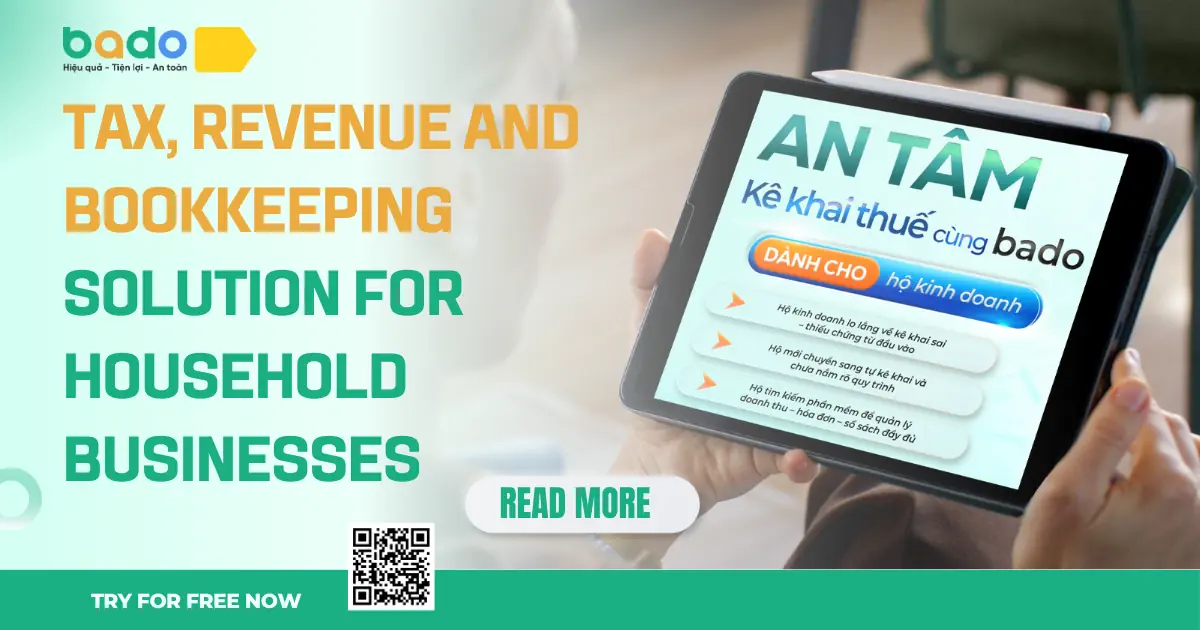
Bado positions its tax, revenue, and bookkeeping solution for household businesses as an easy-to-use, practical platform connected with daily sales operations. It is designed to support the transition from manual management to data-driven management. This is not only a compliance support tool, but also a foundation for more professional, transparent, and scalable household business operations.
A tax, revenue, and bookkeeping solution for household businesses is a system that helps business owners connect key operational data in one workflow: sales, payments, e-invoices, revenue, products, customers, staff, expenses, bookkeeping records, and reports. Instead of handling each task with a separate tool, a comprehensive solution brings these data points together so household businesses can track, reconcile, and prepare information more easily.
The biggest difference between a comprehensive solution and disconnected manual management is data connection. If a household business uses one tool for sales, another for e-invoices, Excel for bookkeeping, phone photos for expense records, and manual calculation for daily revenue, data will easily become inconsistent. When the owner needs to review information, they have to check multiple sources. This takes time and increases the risk of errors.
A proper solution should help household businesses answer essential management questions:
Management Question
Required Data
How much did we sell today?
Revenue by order, shift, staff member, and sales channel
Which transactions already have invoices?
Invoice status linked with sales orders
Which products sold the most?
Product, inventory, and sales data
Does sales revenue match issued invoices?
Sales and invoice reconciliation reports
Are bookkeeping records complete?
Revenue, expense, inventory, and cash records
Is there enough data for tax preparation?
Revenue, invoice, expense, and report data
For household businesses, this solution should not be as complex as an enterprise ERP system. The users are often business owners, family members, sales staff, cashiers, or the person responsible for paperwork. Therefore, the software must be easy to use, simple to understand, fast to operate, and closely aligned with real business activities: selling, creating orders, issuing invoices, viewing revenue, recording expenses, reconciling daily results, and tracking bookkeeping data.
It is important to understand that tax management does not begin at the tax declaration stage. It begins when a sales transaction happens. If orders are recorded correctly, invoices are issued properly, revenue is summarized accurately, expenses are stored clearly, and bookkeeping records are updated regularly, tax preparation becomes much easier.
On the other hand, if input data is messy, household businesses will feel overloaded when it is time to declare, reconcile, or review records.
With Bado, the tax, revenue, and bookkeeping solution should act as a bridge between daily sales operations and business responsibility management. Bado does not only help household businesses sell faster. It also helps sales data become the foundation for invoices, reports, bookkeeping, and tax-related preparation.
This is the right approach for household businesses in the new operating environment: it does not need to be overly complicated, but it must be clear, complete, and data-based.
Household businesses need proper tax, revenue, and bookkeeping management because old ways of operating are becoming less suitable for today’s business environment. When a business only has a few transactions per day, manual records may seem enough. But when customer volume increases, staff members are added, products become more diverse, online channels expand, and e-invoice requirements become more important, manual management creates many gaps.
The first gap is the inability to control real revenue. Many household businesses only know how much money is left in the cash drawer or bank account at the end of the day. They may not know which products generated the revenue, which staff member sold them, which shift performed best, which orders were canceled, which payments are still unpaid, or which transactions already have invoices.
Xem thêm: Bado đồng hành cùng hộ kinh doanh chuyển đổi từ thuế khoán sang kê khai
If the owner only looks at the total amount of money received, they can easily confuse revenue, cash flow, debt, expenses, and profit. This is why many household businesses feel that they are “selling well,” but at the end of the month, they still do not know how much profit they actually made.
The second gap is that invoices and revenue may not match. When sales are recorded in one place, invoices are issued somewhere else, and bookkeeping is done separately, household businesses can easily face problems such as orders without invoices, invoices without clear source orders, sales reports that do not match invoice reports, or staff members forgetting to issue invoices when required.
If reconciliation is not done regularly, small differences can accumulate day by day and become major problems later.
The third gap is bookkeeping without a proper data foundation. Bookkeeping should not be created by guessing or reconstructing information long after transactions have happened. It should be built from daily sales, invoices, expenses, inventory, and cash movement. If household businesses do not collect data from the beginning, bookkeeping at the end of a period becomes difficult, stressful, and less reliable.
The fourth gap is lack of tax readiness. When data is unclear, household businesses become passive. They may not know their revenue level, whether invoices have been issued sufficiently, whether expenses are recorded properly, or what they need to prepare for the next reporting or declaration period. This creates unnecessary pressure and increases the risk of mistakes.
Manual Method
Common Risk
Impact
Handwritten revenue records
Missing, incorrect, or lost data
Difficult end-period reconciliation
Separate invoice system
Data does not match sales orders
More time spent checking
Inventory managed by memory
Stock differences and unclear cost
Cannot understand real profit
Expenses stored in photos or messages
Hard to summarize
Bookkeeping lacks evidence
No staff or shift tracking
Hard to assign responsibility
Higher risk of loss
No regular reporting
Errors are detected too late
Increased operational risk
Bado should position this problem practically: household businesses do not need to become complex accounting departments, but they do need a minimum data system to operate safely. Tax, revenue, and bookkeeping management is not only about “doing things for the tax authority.” It first helps the owner understand the business: how much is sold, how much is collected, what stock remains, which invoices have been issued, where expenses are recorded, and whether the data is ready for reconciliation.
Disconnected management is very common among household businesses. An owner may use one app for sales, one Excel file for revenue, another system for invoices, a chat group for staff communication, a notebook for debt records, a folder of photos for receipts, and an external person for tax support when needed.
Each tool solves one part of the work, but none of them gives the owner a complete view.
The biggest problem is fragmented data. A sales transaction should ideally move through one connected flow: create order, receive payment, record customer, issue invoice if needed, update inventory, summarize revenue, record into the appropriate book, and include it in reports.
But when each step happens in a different tool, the business must enter the same data multiple times. The more data is re-entered, the higher the risk of error.
For example, an order may already be recorded in a POS system, but the invoice is created in a separate platform. A staff member enters the wrong product name or amount. At the end of the day, the sales report and invoice report do not match. The owner must check each order manually. If the store has hundreds of transactions per day, manual reconciliation becomes almost impossible.
Many household businesses treat cash collected during the day as revenue, and revenue as profit. This is a common management mistake.
Revenue is the value of sales generated. Cash collected is the actual money received. Profit must consider cost of goods, expenses, staff wages, rent, delivery costs, discounts, losses, and other operating costs.
Without a system that separates these clearly, business owners may misunderstand their financial situation.
When invoices are not linked with sales orders, invoice status becomes difficult to track. Some transactions may require invoices but are missed. Some invoices may be issued but cannot be linked to the original order. Customers may request invoices again, but staff take too long to search. Some incorrect invoices may need handling, but there is no clear status tracking.
All of this increases operational pressure.
Many household businesses do not update bookkeeping regularly. They only collect information when they need to declare, report, or review. This makes data incomplete, receipts missing, expenses unclear, stock inconsistent, and revenue hard to verify.
Effective bookkeeping should be supported by daily business data, not reconstructed at the last minute.
Xem thêm: Rà soát, cảnh báo sớm sai sót, giảm thiểu rủi ro cho hộ kinh doanh
When data is fragmented, owners cannot rely on reports. They may not know which products generate the most revenue, which customers buy often, which staff member sells well, which shift often has cash differences, which sales channel performs best, or which expense category is increasing abnormally.
As a result, business decisions are based mostly on feelings. Feelings may be useful, but they are not enough for long-term growth.
Fragmented Data
Problem Created
Needed Approach
Separate order data
Hard to reconcile with invoices
Link invoices with sales orders
Separate invoice data
Hard to understand real revenue
Connect invoices with reports
Separate bookkeeping
Lacks transaction foundation
Summarize from daily data
Separate expenses
Hard to calculate profit
Store and classify expenses
Separate staff tracking
Link actions to staff accounts
Separate inventory
Stock differences
Sync sales and inventory
Bado should solve this problem with a clear message: household businesses do not lack tools; they lack a unified data flow. When sales, invoices, revenue, bookkeeping, and reports are connected in one system, owners do not only operate more correctly; they also understand their business better.
A tax, revenue, and bookkeeping management solution for household businesses must start with data. Without correct data, there can be no correct reports. Without correct reports, tax preparation, bookkeeping, and decision-making become unreliable.
Before discussing features, it is important to define which data layers household businesses need to manage.
Sales data is the first foundation. Each transaction should record at least the product or service sold, quantity, unit price, total amount, sales time, payment method, staff member, customer information if available, and order status.
This data is not only used to calculate revenue. It also supports inventory control, invoice issuance, business reports, and bookkeeping.
If sales data is not clean, everything that follows becomes unreliable. For example, product names may be inconsistent, prices may be unclear, canceled orders may still be counted as revenue, payment methods may not be recorded, or customer information may be missing.
Invoice data helps household businesses know which transactions already have invoices, what the invoice status is, who the buyer is, what the total value is, and whether any adjustment is needed.
For household businesses that need or want to use POS-generated e-invoices, invoice data should be closely connected with POS or sales software.
Revenue and cash flow must be separated clearly. Revenue is the value of sales generated. Cash flow is the money actually received or paid.
An order may generate revenue but not be fully paid yet. A bank transfer received today may be payment for debt from a previous period. If these are not separated, household businesses can misunderstand their financial position.
The software should help view revenue by day, week, month, product, staff member, shift, branch, sales channel, and payment method. It should also support tracking cash, bank transfers, receivables, and basic expenses.
For household businesses that sell goods, inventory is essential. If sales do not update inventory, the owner cannot know what remains, what sells fast, what stays too long, and what may be lost.
Inventory is also related to cost of goods and profit. Managing revenue without managing products and inventory only shows the sales side, not the cost side.
Expenses are often overlooked by household businesses. Rent, staff wages, product purchases, delivery, packaging, electricity, marketing, equipment, repairs, software fees, and other costs all affect real profit.
Not every expense needs to be processed in a complicated way, but there should be a place to record, classify, and summarize them.
Bookkeeping organizes business data into a more structured format. It may include revenue records, expense details, inventory details, product movement, cash records, and other information depending on the applicable requirements.
The key point is that bookkeeping should be built from real business transactions. It should not be created separately from sales, invoices, inventory, and cash data.
Data Layer
Role
Sales
Foundation for transaction recording
E-invoices
Digital documents linked to transactions
Revenue
Tracks business scale and sales performance
Cash flow
Tracks actual money received and paid
Inventory
Controls stock and cost of goods
Expenses
Helps understand actual profitability
Bookkeeping
Structures data for management and preparation
Reports
Supports decision-making
Bado should communicate that tax management is not a standalone feature. It is the result of a correct data chain: proper sales recording, correct invoices, clear revenue, recorded expenses, complete bookkeeping data, and easy-to-understand reports.
Bado can position its solution as a simple but comprehensive operating ecosystem for household businesses. Instead of forcing business owners to use many disconnected tools, Bado connects key activities in one platform: sales, customers, products, staff, e-invoices, revenue, reports, and bookkeeping data.
When household businesses sell through Bado, each transaction becomes data. Revenue is no longer a number manually calculated at the end of the day. It can be summarized by order, time, staff member, shift, payment method, product, and sales channel.
This helps owners know what was sold, who sold it, how payment was received, and where revenue came from.
This is the foundation for tax and bookkeeping management. If revenue is not recorded correctly from the start, everything after that becomes more difficult. Bado should emphasize that tax readiness begins with proper sales management.
E-invoices should be treated as part of the overall management flow. When sales orders and invoices are linked, household businesses can search, reconcile, and reduce repeated data entry more easily.
This is a major difference compared with using sales software in one place and invoice software in another.
Bado can help household businesses manage product catalogs, stock in and stock out, sold goods, remaining inventory, and product groups. This supports revenue tracking by product and provides a clearer data foundation for inventory and goods-related records.
For industries such as grocery, agricultural supplies, fashion, pharmacy, accessories, and F&B, inventory is one of the areas most likely to become inconsistent if managed manually.
Household businesses do not only need to know revenue. They also need to understand cash flow and expenses. Bado can support owners in tracking income, expenses, receivables, cash, bank transfers, and overview reports.
When these data points are centralized, owners can understand whether the business is truly healthy.
Bado should not position itself as a replacement for professional tax advisory if that service scope is not clearly defined. A more accurate message is that Bado helps household businesses standardize input data so that tracking, bookkeeping, reconciliation, and tax preparation become easier.
How Bado Supports
Value for Household Businesses
Sales management
Records revenue from actual transactions
E-invoice management
Links invoices with orders and revenue
Inventory management
Tracks goods sold, remaining stock, and movements
Customer management
Stores buyer data and supports invoice search
Staff management
Shows who created orders and performed actions
Financial reports
Tracks revenue, cash flow, and business performance
Bookkeeping data support
Provides a foundation for records and reconciliation
Tax preparation support
Helps prepare clearer data for declaration
Bado should emphasize that it does not make tax management heavy or complicated. It helps household businesses bring daily activities into a clearer system.
A sale creates data. Data creates reports. Reports support reconciliation. Invoices and bookkeeping connect with transactions. From there, household businesses become more prepared for tax responsibilities and more confident in managing operations.
Many household businesses confuse sales software, e-invoice software, accounting software, and a complete tax, revenue, and bookkeeping management solution. These tools are related but not the same.
Sales software focuses on transactions: creating orders, calculating payments, managing products, inventory, customers, staff, and revenue.
E-invoice software focuses on creating, issuing, sending, storing, and managing invoices.
Accounting software focuses on accounting entries, financial records, reports, and financial obligations.
A tax, revenue, and bookkeeping solution for household businesses should connect these layers at a level that is practical for household business operations.
Solution Type
Main Focus
Risk If Used Alone
Sales software
Orders, products, customers, revenue
Sales data exists, but invoices and bookkeeping remain separate
E-invoice software
Invoice creation and management
Invoice data may need manual entry from sales
Accounting software
Accounting records and reports
May be too complex if sales data is not prepared
Tax, revenue and bookkeeping solution
Connects sales, invoices, revenue, bookkeeping, and reports
Reduces fragmentation and improves reconciliation
A small household business may not need a complex accounting system like a large enterprise. However, it still needs clear records of revenue, invoices, products, cash, and expenses.
If it only uses sales software, it may sell quickly but still lack sufficient data for bookkeeping. If it only uses e-invoice software, it may issue invoices but still cannot control inventory, staff, customers, and actual revenue. If it only uses Excel for bookkeeping, it still depends heavily on manual entry.
The better approach is to build a unified data flow. Sales software is the starting point. E-invoices are the document layer. Inventory and customer management are the operating layer. Reports are the management layer. Bookkeeping structures the data. Tax preparation relies on that data.
Bado should position itself as the connector of these layers for household businesses. It is not only a sales app and not only an invoice tool. It is a solution that helps household businesses manage more professionally step by step: from mobile sales management, revenue tracking, e-invoice issuance, bookkeeping data, and tax preparation support.
A comprehensive tax, revenue, and bookkeeping solution offers value beyond regulatory compliance. When implemented properly, it helps business owners understand operations, reduce errors, save time, manage more transparently, prepare better data, and reduce pressure during reporting or reconciliation periods.
The first benefit is that owners know where revenue actually comes from. Instead of only seeing the total money collected at the end of the day, they can view revenue by product, product group, staff member, shift, sales channel, payment method, and time period.
This helps identify best-selling products, effective shifts, strong employees, and unusual patterns in operations.
When orders and invoices are connected, household businesses can know which transactions already have invoices, which ones do not, which invoices require attention, and which revenue has been recorded.
This reduces differences between sales data and invoice data and saves time during reconciliation.
Bookkeeping becomes easier when data is recorded consistently from the beginning. When revenue, expenses, products, and cash data are already available, record preparation depends less on memory or last-minute document collection.
When revenue, invoices, and bookkeeping data are clear, household businesses become more proactive. Owners can understand their revenue level, check which data is missing, and prepare more confidently for upcoming declaration or reconciliation periods.
Clear data helps household businesses operate like professional small enterprises. Owners can understand which products are profitable, which customers buy often, which employees sell well, which expenses are increasing, which revenue sources are stable, and which season requires more stock preparation.
Benefit
Direct Impact
Clear revenue
Know what sells, where it sells, who sells, and how much is collected
Invoice-data connection
Reduce mismatches and repeated entry
Bookkeeping data foundation
Easier records with less dependence on memory
Expense tracking
Understand real profit better
Easy reports
Make faster decisions
Tax readiness
Reduce pressure during declaration and reconciliation
Transparent operations
Suitable for business expansion
For Bado, these benefits should be communicated in household business language: no more confusion when calculating revenue, sales automatically create data, invoices are linked to orders, bookkeeping becomes less manual, profit is clearer, tax preparation becomes easier, and household businesses can operate more like professional SMEs.
Choosing a tax, revenue, and bookkeeping solution for household businesses should not be based only on how many features the software has. The more important question is whether the software fits the real operating workflow of the household business.
A retail shop, restaurant, pharmacy, agricultural supply store, spa, or fashion store may operate differently, but all of them need clear sales, revenue, invoice, bookkeeping, and reporting data.
The first criterion is ease of use. Household businesses usually do not have a professional accounting department. The users may be the owner, cashier, sales staff, or a family member.
The software should use simple language, clear workflows, and an easy interface. It should avoid unnecessary accounting complexity for daily users.
A suitable solution should start where the data is created: sales. If the software requires data to be entered only after transactions happen, the household business still has to do too much manual work.
A good system should help create orders, record revenue, update inventory, store customer information, and build data for invoices, bookkeeping, and reports.
As e-invoices become increasingly important, the solution should support or connect with e-invoice workflows. This is especially important for household businesses that have higher revenue, many transactions, or need POS-generated invoice support.
Reports should not be only for accountants. Business owners need to understand revenue, expenses, invoices, inventory, cash, receivables, and performance in a simple way. If reports are too difficult to read, the software will not create real management value.
Household businesses need guidance on how to enter data, create orders, issue invoices, review reports, record expenses, reconcile data, and prepare bookkeeping information.
A good solution should include support, especially when the business is moving from manual processes to software-based management.
Selection Criteria
Key Question
Ease of use
Can the owner and staff use it quickly?
Sales-based data
Does data come from real sales orders?
E-invoice support
Can it support or connect e-invoice workflows?
Revenue management
Can revenue be viewed by day, shift, staff, and product?
Bookkeeping support
Does it provide a data foundation for records and reconciliation?
Reporting
Can the owner understand reports in minutes?
Support
Is there guidance during implementation?
When choosing software, household businesses should ask: Does this tool reduce manual entry? Does it make revenue clearer? Does it connect invoices with orders? Does it support bookkeeping data? Does it help prepare tax-related information more easily? Can sales staff use it without difficulty?
If the answer is yes, the solution is suitable.
Implementing a tax, revenue, and bookkeeping management solution is not just about installing software. To be effective, household businesses need to standardize data, workflows, and daily habits.
Software only creates value when data is entered correctly, staff use it consistently, owners review reports regularly, and sales, invoices, and bookkeeping are connected.
The first step is to standardize product names, service names, units, prices, product groups, and product codes if available. If product names are inconsistent, revenue reports become messy, invoices can be unclear, and bookkeeping becomes harder.
Household businesses should invest time in doing this properly from the beginning.
The business should define when to create an order, when to collect payment, when to issue an invoice, who is responsible, where customer information comes from, and how invoice status is tracked.
If the process is clear, staff can follow it more easily. If the process is vague, even good software can be used incorrectly.
Household businesses should build a habit of recording expenses when they happen or on a fixed daily or weekly schedule. They should avoid waiting until the end of the month, because expenses may be forgotten or documents may be lost.
The clearer expenses are, the better the owner understands real profit.
Owners should check revenue daily or by shift: total orders, cash, bank transfers, issued invoices, canceled orders, returned orders, and receivables.
Regular reconciliation helps detect differences early instead of allowing errors to accumulate until the end of the month.
Reports should not only be stored. Owners should use them to make decisions: which products to restock, which items stay too long, which staff member performs well, which shift needs more people, which expense is increasing, which revenue source is decreasing, and which sales channel is effective.
When reports are used regularly, software becomes a real management tool.
Implementation Stage
Key Action
Expected Result
Week 1
Standardize products, services, and units
Cleaner sales data
Week 2
Set sales-to-invoice workflow
Fewer missed invoices and repeated entries
Week 3
Record basic expenses, cash, and receivables
Better cash flow visibility
Week 4
Review revenue, invoice, and inventory reports
More transparent reconciliation
Month 2 onward
Optimize bookkeeping data, permissions, and reports
More stable and professional operations
Bado should communicate that implementation does not need to begin heavily. Household businesses can take it step by step: record sales properly first, make revenue clear, connect invoices, record expenses, summarize bookkeeping data, and use reports for decisions.
The most important thing is to start from real daily transaction data.
Tax, revenue, and bookkeeping management is no longer a secondary task for household businesses. It is a foundation for transparent operations, clearer revenue tracking, fewer invoice errors, more complete bookkeeping data, and greater readiness for tax-related responsibilities.
As business operations become more data-driven, household businesses need a system that connects sales, invoices, revenue, expenses, inventory, customers, staff, and reports.
Bado approaches this challenge practically. It does not make management more complicated. Instead, it brings daily business data into a clearer workflow. Sales create data. Data creates reports. Reports support reconciliation. Invoices and bookkeeping connect with transactions. From there, household businesses gain a stronger foundation for tax preparation, revenue tracking, and professional operation.
As a core pillar page, this article should define the entire topic cluster “tax, revenue, and bookkeeping management for household businesses” on Bado’s website. Supporting articles about e-invoices for household businesses, POS-generated e-invoices, household business tax declaration, household business bookkeeping, transition from presumptive tax to declaration-based management, free sales management software, household business revenue management, and household business tax calculation should internally link back to this page.
This structure helps avoid duplicate search intent and allows search engines to understand that this is the central page for household business management in the new operating environment.
Are you still managing sales, revenue, invoices, and bookkeeping with disconnected tools?
It may be time to standardize your entire workflow on one easy-to-use platform.
Bado helps household businesses manage sales, revenue, e-invoices, customers, products, staff, reports, and bookkeeping data in one connected system.
Start using Bado to manage your household business more professionally, reduce errors, reconcile revenue more clearly, and become more proactive with tax-related responsibilities.
It is a system that connects sales, revenue, e-invoices, products, expenses, cash, bookkeeping data, and reports. The goal is to help household businesses manage more transparently, reconcile more easily, and prepare better data for bookkeeping, reporting, or tax-related tasks.
Yes, depending on applicable regulations and business conditions. Household businesses should track revenue, expenses, products, cash, and related data so they can manage operations and prepare information when needed.
Revenue is the value of sales generated. Cash collected is the actual money received. A sale may generate revenue but remain unpaid, while money received today may be payment for a previous debt. Household businesses should track both to understand the real situation.
E-invoices reflect transactions and should be reconciled with sales revenue. If invoices and orders are not connected, businesses may face mismatched data, missing invoices, or difficulties when searching past transactions.
Bado supports sales management, revenue tracking, e-invoices, bookkeeping data, and reports. It helps household businesses standardize input data so tracking, reconciliation, and preparation become easier. For complex tax situations, businesses should consult the tax authority or qualified tax professionals.
Start with sales data: products, orders, revenue, payment methods, and customers. Then connect e-invoices, inventory, expenses, cash, receivables, reports, and bookkeeping data. Accurate transaction data makes all later steps easier.
Not completely. Sales software is important because it records orders, revenue, products, and customers. However, better tax and bookkeeping management also requires e-invoice connection, revenue reports, expense records, bookkeeping data, and reconciliation.
High revenue does not always mean high profit. Without recording product costs, rent, wages, delivery, utilities, marketing, and other expenses, owners cannot know real profit. Expense tracking supports better business decisions.
Yes. Bado can help standardize sales, revenue, e-invoice, customer, product, staff, and report data. This makes it easier for household businesses to review and prepare information for bookkeeping or tax-related tasks.
Bài viết liên quan
27/7/2026 0 lượt xem
27/7/2026 2 lượt xem
27/7/2026 1 lượt xem
25/7/2026 15 lượt xem
25/7/2026 20 lượt xem
25/7/2026 6 lượt xem
25/7/2026 8 lượt xem
25/7/2026 18 lượt xem
Bài viết nổi bật
2/6/2023 5995 lượt xem
12/11/2025 2147 lượt xem
5/5/2025 1790 lượt xem
5/8/2024 1646 lượt xem
21/9/2024 1426 lượt xem
21/8/2024 1410 lượt xem
10/8/2024 1371 lượt xem
15/4/2026 1305 lượt xem
14/5/2026 1127 lượt xem
6/3/2026 1113 lượt xem
Dùng thử miễn phí phần mềm Bado để tối ưu quản lý cửa hàng ngay hôm nay
...
Hỗ trợ tra cứu, xử lý nghiệp vụ & tư vấn 24/7